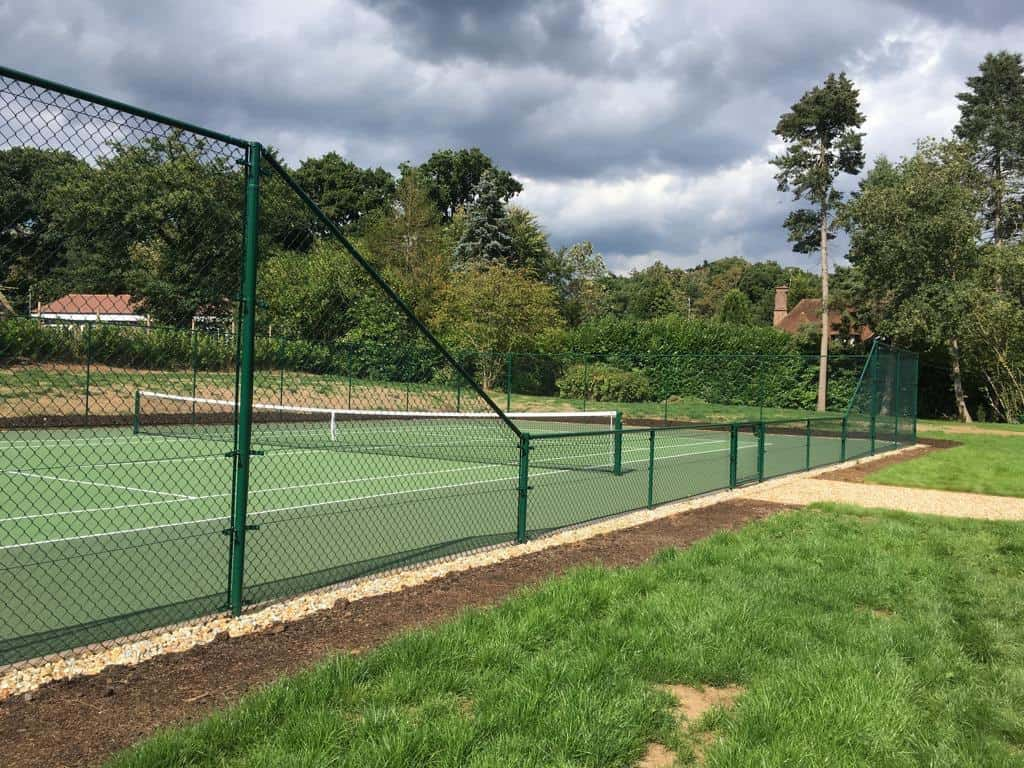
A tennis court will naturally change as it ages. Regular use, weather exposure, surface contamination and gradual deterioration can all affect its appearance and playing characteristics. Small defects can often be dealt with through targeted maintenance or localised repairs, particularly when the wider court remains in good condition.
There can, however, come a point when repeatedly repairing individual areas no longer addresses the overall condition of the court. Cracks may return, surface wear can become widespread, drainage performance may deteriorate, and several previously repaired areas can begin affecting the consistency of the playing surface.
For tennis courts in Essex, UK, deciding between another minor repair and more comprehensive refurbishment should therefore be based on the condition of the complete court. Refurbishment becomes particularly valuable when deterioration is no longer isolated and restoring several aspects of the surface together will provide a more consistent result.
How Do You Know When a Tennis Court Needs Refurbishment Rather Than Another Repair?
Minor repairs are generally most appropriate when defects are localised and the surrounding court remains stable, consistent and suitable for continued use.
Refurbishment becomes more appropriate when deterioration affects a substantial proportion of the playing area or when several different problems have developed together.
The decision should consider the surface condition, cracking, levels, drainage, grip, previous repairs and the underlying cause of recurring defects rather than relying on appearance alone.
Minor Repairs Have an Important Role
Not every crack, worn patch or small defect means that a tennis court needs comprehensive refurbishment.
Where deterioration is confined to a particular area, targeted repairs can help maintain an otherwise serviceable court.
This is particularly useful when the surrounding surface remains consistent and there is no evidence of a broader problem.
The important distinction is whether the repair addresses an isolated defect or is simply another temporary response to widespread deterioration.
Repeated Repairs Can Indicate a Wider Problem
One of the clearest reasons to consider refurbishment is a pattern of recurring repairs.
If the same areas repeatedly require attention, it is worth asking why the defect continues to develop.
Likewise, if one section is repaired only for deterioration to appear somewhere else, the problem may no longer be genuinely localised.
At this stage, continuing to patch individual sections can create an increasingly inconsistent court without addressing the wider condition.
Look at the Court as a Complete Playing Surface
A tennis court needs to function as one continuous surface.
This makes its condition different from an area where isolated appearance is the main concern. Changes across different sections can affect how consistently players move and how the ball behaves.
When assessing whether refurbishment is appropriate, it is therefore important to look beyond the most visible defect.
The condition of the complete playing area provides a much better indication of what work is required.
Widespread Surface Wear Can Justify Refurbishment
Over time, frequently used sections of a tennis court can become noticeably more worn than others.
The surface may begin losing its original texture, and differences can develop between high-use and lower-use areas.
A small worn section can sometimes be treated locally.
Where wear has become widespread, however, repairing individual patches may leave significant variations across the playing area.
Refurbishment provides an opportunity to address the surface more comprehensively.
Surface Consistency Matters for Play
A tennis court does not only need to look tidy.
The surface should provide reasonably consistent characteristics across the playing area.
When one section is significantly smoother, rougher or more deteriorated than another, players may begin noticing differences as they move around the court.
The ball can also interact differently with areas that have experienced varying levels of wear.
Refurbishment can be valuable when restoring consistency has become more important than repairing individual visible defects.
Cracks Should Be Assessed by Their Pattern
Cracking is one of the most obvious signs of tennis court deterioration, but not every crack has the same significance.
An isolated crack may be suitable for targeted repair.
Numerous cracks developing across different parts of the court indicate a different condition.
The pattern, extent and recurrence of cracking should all be considered before deciding whether another localised repair is appropriate.
Returning Cracks Need Further Investigation
If a crack has already been repaired but later becomes visible again, simply repeating the same treatment may not provide a lasting answer.
The cause of the movement needs to be considered.
A surface repair can only address what is happening at the upper layer. Where movement originates from deeper within the construction, treating the visible crack repeatedly may not resolve the underlying issue.
Professional assessment can determine whether the problem remains suitable for repair or requires a broader refurbishment approach.
Multiple Cracks Can Change the Practicality of Patch Repairs
Repairing one or two isolated cracks can be a sensible maintenance measure.
When cracks become numerous, however, the situation changes.
Large numbers of repaired sections can leave the court looking increasingly patched and may create differences in texture across the surface.
At some point, treating the playing area as a whole can provide a more coherent result than continuing to address each crack independently.
Surface Fading Alone Does Not Always Mean Refurbishment Is Necessary
A tennis court can lose some of its original appearance while remaining functional.
Fading should therefore be considered alongside the physical condition of the surface rather than treated as an automatic reason for extensive work.
If the surface remains stable and consistent, the appropriate treatment may be relatively straightforward.
Where fading accompanies widespread wear, cracking and deterioration, however, it can form part of a wider case for refurbishment.
Loss of Surface Texture Can Affect Court Performance
Surface texture contributes to how the court performs underfoot and how it interacts with the ball.
As the playing surface wears, areas can gradually become smoother or otherwise change in character.
If these changes are confined to a small area, local treatment may be possible.
When they extend across much of the court, a comprehensive surface treatment can provide a more consistent outcome.
Drainage Problems Should Not Be Ignored
Water management is an important part of tennis court performance.
A court should be constructed so that rainfall can clear appropriately rather than remaining unnecessarily across the playing area.
If water increasingly collects in certain locations, the reason should be investigated.
Surface deterioration, contamination, localised depressions or wider changes within the court can all contribute to drainage difficulties.
The correct solution depends on the cause.
Persistent Ponding Can Indicate More Than a Surface Defect
A small amount of temporary surface water after rainfall does not necessarily indicate a major problem.
Persistent ponding in the same locations deserves closer attention.
If the affected area has developed a depression, applying another surface coating will not necessarily correct the underlying level.
The condition beneath the visible surface may need to be considered before refurbishment is planned.
This prevents cosmetic work being used where structural correction is actually required.
Poor Drainage Can Accelerate Surface Deterioration
Where water repeatedly remains on a tennis court, affected sections can experience increased contamination and weathering.
Over time, this can contribute to a cycle in which drainage difficulties and surface deterioration become connected.
Addressing only the visible wear without considering water movement may therefore provide limited benefit.
A professional refurbishment assessment should consider how the court performs during wet conditions as well as when dry.
Moss and Organic Growth Can Affect the Surface
Outdoor courts can accumulate moss, algae and other organic contamination.
This can change both the appearance and usability of the playing surface.
Where the underlying court remains in suitable condition, professional cleaning and maintenance may be sufficient.
However, contamination can also conceal cracks, worn areas and previous repairs.
Assessing the surface after appropriate preparation can provide a clearer understanding of whether more extensive refurbishment is necessary.
Cleaning Cannot Correct Physical Deterioration
Cleaning is valuable maintenance, but it has limitations.
It can remove surface contamination and reveal the underlying condition, but it cannot repair cracks, restore failed areas or correct depressions.
If a court continues looking or performing poorly after contamination has been addressed, physical deterioration may be responsible.
This distinction helps prevent maintenance treatments being expected to solve problems they cannot correct.
Previous Repairs Should Be Reviewed
An older tennis court may contain several previous repair areas.
This is not automatically a problem. Well-executed localised repairs can help extend the useful life of a court.
The concern arises when repairs begin accumulating throughout the playing area.
Numerous patches can indicate that different parts of the surface are reaching a similar stage of deterioration.
Reviewing the number, location and condition of previous repairs can therefore help determine whether another patch is worthwhile.
A Patchwork Surface Can Become Increasingly Inconsistent
As repeated repairs accumulate, different sections of the court may contain materials of different ages and textures.
Even where each individual repair remains functional, the complete surface can gradually lose uniformity.
This can become noticeable both visually and during play.
Refurbishment provides an opportunity to treat the wider area as one surface again rather than continuing to add individual patches.
Court Markings Can Also Become Worn
Playing lines gradually deteriorate alongside the surrounding surface.
Faded or worn markings may become increasingly difficult to distinguish.
Line wear alone does not necessarily justify comprehensive refurbishment, but it can form part of a wider deterioration pattern.
Where the surface already requires significant attention, renewing the playing markings can form part of the overall refurbishment process.
Refurbishment Can Restore a More Uniform Appearance
An ageing court may contain faded sections, repairs, stains and areas of varying texture.
Even if no single defect is severe, the combined effect can make the entire court appear tired.
Refurbishment can address the surface more comprehensively, producing a more consistent finish across the playing area.
Appearance should not be the only consideration, but it is an important part of restoring a court that is otherwise suitable for continued use.
The Underlying Construction Must Be Considered
A tennis court is more than its visible surface.
The performance of the upper layer depends significantly on what lies beneath it.
If the underlying construction remains stable, refurbishment can often provide an effective way of renewing a worn surface.
If substantial movement or deterioration exists below, simply applying new surface treatments may not provide an appropriate long-term result.
This is why assessment should come before deciding on the scope of refurbishment.
Refurbishment Is Not a Substitute for Structural Correction
There is an important distinction between a worn court and a structurally compromised one.
A worn but fundamentally stable surface can be a strong candidate for refurbishment.
A court with substantial settlement, extensive movement or serious underlying failure may require more extensive corrective work.
Attempting to conceal structural defects beneath a new surface can allow the same problems to reappear.
The underlying condition should therefore guide the treatment.
Uneven Areas Need Proper Investigation
If sections of the court have noticeably sunk or changed level, the cause should be established.
Localised settlement can create water collection points and affect the consistency of the playing surface.
A superficial treatment cannot necessarily restore appropriate levels.
Professional assessment can determine whether the affected area can be corrected locally or whether broader work is needed before resurfacing.
Edge Deterioration Can Spread Inwards
The perimeter of a tennis court is sometimes overlooked because attention naturally focuses on the main playing area.
However, deterioration can begin around edges where vegetation, water or general weathering affects the surface.
If edge defects remain localised, they may be repairable.
Where deterioration has progressed around substantial sections of the perimeter, including these areas within a wider refurbishment can provide a more complete result.
The Surrounding Court Area Should Be Assessed
A refurbishment assessment should not stop at the service lines.
The complete surfaced area contributes to the usability and appearance of the facility.
Perimeters, run-off areas and transitions should be examined alongside the primary playing surface.
Treating only the central court while leaving extensive surrounding deterioration can limit the overall improvement.
Minor Repairs Are Best When Problems Are Truly Localised
Targeted repairs remain valuable when the court is fundamentally sound.
They can be particularly appropriate where:
- One or two isolated cracks have developed
- A small section of surface has become damaged
- Most of the playing area remains consistent
- Drainage continues to perform appropriately
- Previous repairs remain stable
- There is no widespread surface deterioration
- The underlying construction appears sound
In these circumstances, comprehensive refurbishment may be unnecessary.
Refurbishment Becomes More Appropriate When Problems Overlap
The case for refurbishment becomes stronger when several issues occur together.
For example, a court may contain widespread fading, numerous cracks, worn high-use areas, previous repairs and declining surface texture.
Each problem could potentially be treated individually.
However, when they affect a large proportion of the court, addressing them together can provide a more coherent result.
Refurbishment Can Extend the Useful Life of a Suitable Court
A deteriorated surface does not automatically mean the complete tennis court needs rebuilding.
Where the underlying construction remains suitable, refurbishment can renew important aspects of the court while retaining serviceable elements.
This makes accurate assessment particularly important.
The objective is to identify what can reasonably be retained and which components need attention to restore the court effectively.
Timing Refurbishment Before Severe Deterioration Can Be Beneficial
Waiting until every part of a tennis court has substantially deteriorated is not necessarily the best approach.
When surface wear and cracking become increasingly widespread, earlier assessment can determine whether refurbishment could address the problems while the underlying construction remains suitable.
Continuing with repeated small repairs for too long can allow the surface to become increasingly fragmented.
A planned approach provides an opportunity to deal with deterioration as a whole.
Refurbishment Should Have Clear Objectives
Before work begins, it is important to understand what the refurbishment is intended to achieve.
Depending on the court’s condition, objectives may include:
- Repairing cracks and damaged areas
- Restoring a more consistent playing surface
- Addressing localised level problems
- Improving surface appearance
- Renewing worn court markings
- Treating deterioration around the perimeter
- Preparing the surface for an appropriate coating system
- Improving the overall usability of the court
The exact scope should be determined by the existing condition rather than applying the same treatment to every court.
Surface Preparation Is Critical
A successful refurbishment depends heavily on preparation.
Applying new treatments over contamination, loose material or unresolved defects can compromise the finished result.
The existing court should therefore be assessed and prepared appropriately before resurfacing work progresses.
This may involve cleaning, repairing cracks and addressing damaged areas so that the renewed surface has a suitable foundation.
Refurbishment Is More Than Repainting a Court
A tennis court refurbishment should not simply be viewed as applying a fresh colour to an ageing surface.
A new coating cannot compensate for unresolved cracking, unstable areas or inappropriate preparation.
The condition of the existing surface must be dealt with first.
Only once necessary repairs and preparation have been completed should the finishing stages become the focus.
Professional Assessment Helps Determine the Correct Scope
The difference between a court that needs several repairs and one that would benefit from refurbishment is not always obvious.
A professional assessment can consider:
- The extent and pattern of cracking
- Previous repair areas
- Surface texture and wear
- Drainage performance
- Ponding and localised depressions
- Court levels
- Edge condition
- Organic contamination
- Playing line condition
- Overall surface consistency
- The apparent stability of the underlying construction
Looking at these factors together provides a much clearer basis for deciding what work is appropriate.
The Goal Is a Reliable and Consistent Playing Surface
Ultimately, refurbishment should improve how the tennis court functions rather than merely change how it looks.
A successful project should address the defects responsible for deterioration and restore greater consistency across the playing area.
Where the existing court is fundamentally suitable, comprehensive refurbishment can provide a practical alternative to allowing repeated minor repairs to dominate its ongoing maintenance.
Professional Tennis Court Refurbishment in Essex, UK
At Tennis Court Construction Essex, we assess the complete condition of an existing tennis court before determining whether localised repairs or broader refurbishment would be more appropriate.
Where defects remain isolated, targeted repairs may continue to provide a suitable solution. Where cracking, wear, previous repairs and surface deterioration have become widespread, refurbishment can provide a more comprehensive way to restore the court.
For tennis courts in Essex, UK, the objective should always be to address the actual condition of the facility rather than carrying out more work than is necessary.
Conclusion
Tennis court refurbishment is generally better than continuing with minor repairs when deterioration is no longer confined to a handful of isolated areas. Widespread surface wear, recurring cracks, numerous previous repairs, declining texture, drainage difficulties and an increasingly inconsistent playing area can all indicate that treating individual defects is becoming less effective.
Minor repairs still have an important role when the surrounding court remains stable and serviceable. The decision changes when several problems begin occurring together or repaired areas repeatedly deteriorate.
The most appropriate approach is to assess the complete court, determine whether the underlying construction remains suitable and identify whether refurbishment can restore a more consistent surface.
If your tennis court in Essex, UK is requiring increasingly frequent repairs or has become noticeably worn across larger areas, contact Tennis Court Construction Essex. We can assess its condition and determine whether targeted repairs or a more comprehensive refurbishment approach is appropriate.
Call us on: 01245 945 895
Click here to find out more about Tennis Court Construction Essex
Click here to complete our contact form and see how we can help with your tennis court.